Wool from the fleece
Washing, carding, and spinning — the stages most visitors never see, because most rugs sold as Zapotec now start from machine-spun yarn.
 The Community GardenTrips & fieldwork
Living Traditions · private apprenticeship
Seven days in Teotitlán del Valle, a Zapotec weaving village in the Oaxaca valley, learning the loom and the dye pots from one family — and leaving with a piece you made, in colours you ground yourself.
The village
Teotitlán paid its tribute in cloth to the Aztecs, then wove for the colony, then for traders in Santa Fe, and now for people who come to it. Sheep and the treadle loom arrived around 1535; everything before that was cotton on a backstrap loom. What did not change is that this is a weaving town, and the families in it still keep their own motifs and their own dye recipes.
Roughly a hundred and fifty families weave here. Only about a dozen still dye with cochineal and indigo, and a handful use nothing else. You will be working with one of them.
Your teacher

Margarita is a master weaver from a family of master weavers in Teotitlán del Valle, and she leads the Zapotec art and language work the foundation supports there. She teaches the week herself, or hands it to one of her family — we tell you who before you pay. Either way it is their workshop, their looms, their pace.
You are the only student that week (or two of you, if you bring someone), so nothing is demonstrated at you and no stage of the work arrives already finished. Every family here keeps its own motifs and its own dye recipes; what you learn is theirs, and they decide what is taught and what is not.
What you study
Washing, carding, and spinning — the stages most visitors never see, because most rugs sold as Zapotec now start from machine-spun yarn.
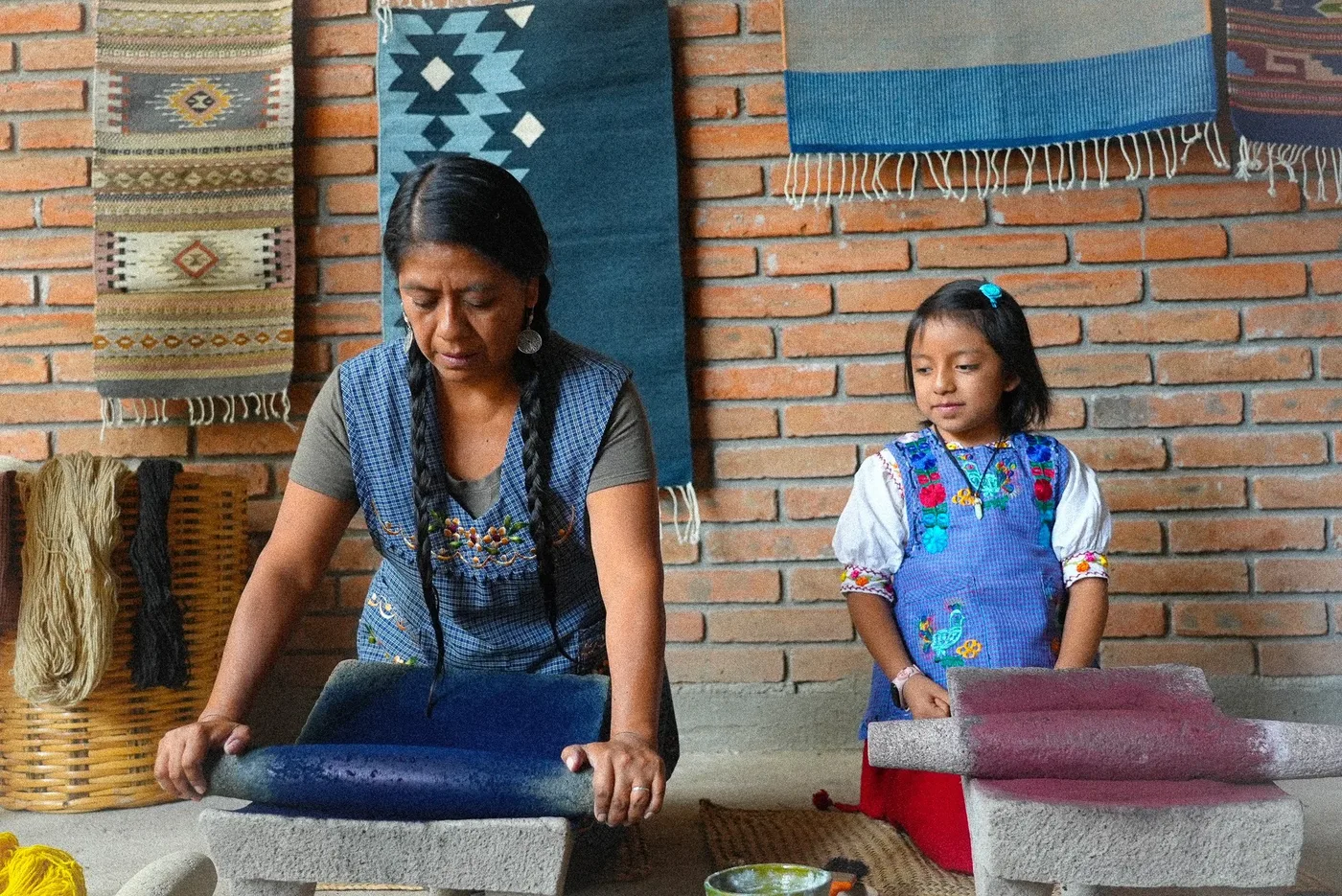
The insect that made Oaxaca rich: how it is farmed on nopal, dried, ground on the metate, and pushed from scarlet to orange to purple with nothing but acid and alkali.
Añil for blue, pericón for yellow, pecan husk for brown, rock moss for green, and what happens when you dye one over another.
Dressing the loom, working the pedals, carrying colour on the shuttle, and beating the weft down until the warp vanishes. It is physical work, and you will feel it.
The greca, the diamond, the Ojo de Dios, the lightning of Cocijo — what the family says each one means, and which ones belong to them.
Zapotec is still the first language of the village. You learn the words for what is in front of you, from people who use them at home and at the loom.
The week
A working shape, not a timetable. Weaving days move around the weather, the dye pots, and what the family has on; the sites and the market stay.
We meet you at Oaxaca airport (OAX) and drive you out through the valley to Teotitlán del Valle, about forty minutes east. You settle in, meet the family you’ll be working with, and eat together. Nothing is asked of you on the first evening.
The week starts where a tapete starts: raw fleece. Washing, carding with hand cards into the little rolls the family calls gusanitos, and spinning. Then the dye pots — alum first, so the colour will hold.
Cochineal is a scale insect farmed on nopal cactus; it takes tens of thousands of them to make a pound. You grind them yourself on the metate, then watch lime juice turn the red to orange and bicarbonate turn it toward purple. Indigo is the other showpiece: yarn comes out of the pot a dull green and turns blue in your hands as the air hits it.
The treadle loom came to Teotitlán with the Spanish around 1535, and the village has woven on it ever since. You dress the loom, learn warp from weft — urdimbre and trama — and start weaving, beating the weft down hard until the warp disappears completely. This is the day your hands stop being clumsy.
Mitla is twenty-five minutes down the road: stone fretwork built from thousands of cut pieces set without mortar, and no two designs in the whole complex repeated exactly. It is the source of the greca you have been weaving. We go, then we come back and you keep weaving with it in your eye.
A day in the city markets: Benito Juárez for chocolate, mole and chapulines, and 20 de Noviembre for the Pasillo de Humo, where you buy your meat raw and they grill it in front of you.
The last day is at the loom: finishing, knotting the fringe, washing and blocking the piece. Your certificate is presented, and we drive you back to the airport. Before you go, the village’s own site: the church at Teotitlán was built on top of a Zapotec temple in 1581, and its walls still carry the carved stones — the same fret you have just woven, in the fabric of the church.
Before you come
Fly into Oaxaca (OAX), which has direct flights from Mexico City and, seasonally, from a few US cities. Teotitlán is about forty minutes east by road. We collect you.
Teaching happens in Spanish and Zapotec. If you don’t speak Spanish, a translator is assigned to you for the week at no extra cost.
November to February is dry, mild and clear. March to May is hotter. Rain comes June to October, usually as afternoon downpours rather than all-day weather.
The village sits at about 1,670 m. Days are warm, nights cool. The loom is physical work — expect to feel your shoulders by day three.
A guesthouse in Teotitlán del Valle, with your own room and your own bathroom, a short walk from the workshop. You are in the village all week, not commuting from the city.
These are private, so the week is built around you. Tell us your preferred dates at checkout and we confirm them with your hosts.
The piece you wove, and a Certificate of Completion in Zapotec Textile Arts & Cultural Studies naming the tradition you studied and the people who taught you.
It is a record of the week, not a qualification. Seven days does not make anyone a Zapotec weaver, and the certificate does not say it does.
Coming soon
We are still setting the first dates with Margarita and her family. Tell us you are interested and we will come to you first when the calendar opens.
Bringing someone? A second person can join you at the same $1,750, learning alongside you with the same teachers.
Questions first? At this price most people want a conversation before they book. Email info@thecommunitygarden.org and we will answer everything below, or set up a call.
Dates: these are private, so we arrange your week together once the calendar opens.
What you pay: the $1,750 covers the full seven days, including teaching, materials, lodging, meals, local transport, and your certificate.